After reading Gareth Dent’s article ‘Dealing with the flood’ and it is interesting to see other people interpretations on “the flood”. In basic terms, the ‘flood’ is all the photos added to the internet in 24 hours, which is a lot hence the word flood. I use photographs to show friends and family what I get up to or where I’ve been. Other people use photos to portray the life they wish they have. However, some people use social media to post photos of their hobby, artwork, or business. I would say I contribute to the flood with my own photographs, not everyday but maybe twice a week. I enjoy adding to the global flood to make myself known every now and again. Of course, I wouldn’t just post anything random, most people have a theme going on their feed.
Research: Context and Meaning in Photography
John A. Walker’s essay ‘Context as a Determinant of Photographic Meaning’.
Notes on Essay:
There are a few particular points in Walker’s essay that I’d like to discuss further:
With each shift of location the photograph is recontextualised and as the context changes so does the meaning.
The first point I feel is correct is right at the beginning where he mentions a wedding photograph and the different contexts it can take on in different locations. For example, he says a wedding photo on someones mantlepiece is a memento whereas a wedding photo in a photographers shop shows off the style of work for that photographer.
The frame of the photograph encloses a space, a world, which we can enter (in our imaginations)
I believe this point is correct because a photo captures only what is in its frame, so it encloses that certain space. However, I cant help but think what if the photo was 2 inches wider, would it change the context?
Two people can identify an image completely different to one another, everyone is different and each have all had different experiences in life.
every person’s response to an image is different and exclusive to them
For example, one person could see an image and think nothing of it at all but the next person to see it could have a huge impact on them, for instance it would bring back certain memories for that individual.
Part 4:1 – Artistic or Utilitarian
I was given the task to flick through a photo album and pick out any photos that are considered “artistic”. It is hard to pick out photos that are considered art because I believe that any photograph can be considered art as no two photos are the same even if the the subject matter is the same. There are a few different photos that I have found that I would consider art in their own ways. See my chosen images below.


The first image is a photograph of my friend and I at our prom night. I believe this photo can be considered art because it has captured a very significant moment that wont happen again. The next two images are photos taken of the sky in different places and different times. This can be seen as art because nature is beautiful and deserves to be captured. The final image is a photo of some street art that I saw in Norwich. This is art because it takes skills to be able to paint like this but also it sends a nice message to its viewers.
The next task was optional but I decided I would give it a go. I was asked to take some shots in my neighbourhood that were purely ‘utilitarian’. I had to find the definition before I went out so I knew what I was looking for. Basically it means something that is designed to be useful rather than attractive. Then try to produce a photo that is more ‘arty’. The first two photos I took mainly showed what my village looked like, for example, the first image is the beginning of Station Road. The second image is a patch of green that is used for kids to play on. The next two photos showed the beautiful buildings that could be considered art and the final image of the sky is taken from my back garden which i have included because it is beautiful.


Part 4:1 – Photography
I am very excited to start this part of the course as Photography is a passion of mine. I currently have a Sony DSLR camera and I really enjoy taking photos of almost anything. Photography has been around since 1826 when the first photograph was taken by Joseph Nicéphore Niépce. Camera Obscura is a model dating back to the 4th century in Greece, a device that projects an inverted image of the view through a hole in the wall.
Renaissance
Caravaggio, born September 1571 in Italy, was one of the first people to use the camera obscura. I found an article discussing whether Caravaggio was the first photographer or not.
The Italian artist has long been suspected of turning his studio into a giant camera obscura, punching a hole in the ceiling to help project images on to his canvas. But new research claims that Caravaggio also used chemicals to turn his canvases into primitive photographic film, “burning” images he then sketched on to for works such as St Matthew and the Angel.
Tom Kington, March 11, 2009.
Contemporary
Abelardo Morell, born 1948, is a modern practitioner who also uses camera obscura. He would cover the windows in house with black plastic then cut a small hole in the middle. This allows the inverted view from outside to be projected on the back wall inside. The image below shows his work. You can see the room is obviously some sort of play room or child’s bedroom considering the toys. The view from that bedroom window is clearly projected onto the opposite wall but upside down, which gives you… camera obscura.

“…photography freed painting from a lot of tiresome chores, starting with family portraits”
Pierre-Auguste Renoir (Coke, 1964, p.66)
Research
The Pencil of Nature
After reading the introductory sections, I think it’s fair to say photography can be both mechanical and creative. Talbot heavily focused on the scientific research that goes into developing photography, trying to figure out the process. A painting usually requires a skilful artist, whereas a photograph necessarily doesn’t. The process itself involves mechanical devices however it is the creative stimulation that triggers it.
Exercise 1
Photography is unique as an art form because it captures the moment. When a fun day out with the family wants to be remembered in the future, you capture the moment by taking a photo. Looking back on old family photos can bring back feelings of nostalgia.
Often the camera can capture what the human eye cannot see. For example, the human eye is able to observe events at fast paces, however, it can’t freeze time or moments. Whereas a camera can, as shown below.

A photograph doesn’t necessarily have to exist in a hard copy. In my opinion, whether a photograph exists in a hard copy or digitally on a phone for example, I believe either can bring you the feelings of nostalgia. However, within art, I think it depends on the context. For a photograph to be considered art, I think the best way to do that would be a hard copy.
“The context in which a photograph is seen… [affects] ..the meanings a viewer draws from it”
Shore, 2010, p 26
Michelangelo Merisi da Caravaggio. At: https://www.nationalgallery.org.uk/artists/michelangelo-merisi-da-caravaggio [accessed 22/01/20]
Was Caravaggio the first photographer? By Tom Kington, March 11, 2009. At: https://www.theguardian.com/artanddesign/2009/mar/11/caravaggio-art-studio-photography-first [accessed 22/01/20]
The Visual Delights of the Camera Obscura (video), CBS News, January 2017. At: http://www.abelardomorell.net/project/camera-obscura/ [accessed 22/01/20]
The Pencil of Nature, by William Talbot. At: thepencilofnature.com [accessed 22/01/20]
Part 3:4 – Cutting Edge
The definition of cutting edge means the most advanced developments. For example, for every mainstream Facebook, there are dozens of smaller companies testing out new ways to engage an audience online.
Futurefarmers.com is an interesting page about farmers that have created new technology such as “Wind Theater” (2019) and many other designs “for exchange that catalyse moments of ‘not knowing'”. Communiculture is a website that seems basic with the logo as that main screen, however, I cant seem to get passed the login screen. I also couldn’t access Theyrule.net as it was stuck on the loading screen.
I decided to research sites that interact with the viewer. It’s hard to know what to search when looking for these things. I have come across Ono, it is a zero waste and highly personalized meal delivery service that uses your body statistics to personalise your order. The website uses contrasting earthy tones to separate the visuals from the text. It guides the audience through the process of personal health and dietary options to suggest the best food recommendations.

Another example of interactive design is the Nike By You. I remembered I used to design my own trainers on this website when I was younger. You could personalise the colours you like and what styles.

The examples I have found suggest they are messages to persuade or entertain people to draw in more clients or customers.
Part 3:4 – Visual Conventions of Time & Place
For this exercise, I was asked to find examples of different visual conventions used to convey time and/or place. I was given the option to explore the OCA online library and use some of the resources on there. I tried to research graphic novels and comics on there but I struggled to find anything.
I researched graphics novels on the normal browser and I found an article that tells us the best comic book artists. There was a few names mentioned such as Marnie Galloway, Craig Thompson and Fiona Staples and many more. They have all won Eisner awards for their work, for example, Craig Thompson won the 2004 Eisner award for Best Graphic Album.
I got thinking and I then researched the Dr Who graphic novels and came across some interesting things. The novel explores the theme of place through multiple frames. We already know that Dr Who teleports to different locations so that challenges the idea of place. We can see here below that he mentions the North Pole. Then below, the doctor gets into the tardis and travels to a new location.


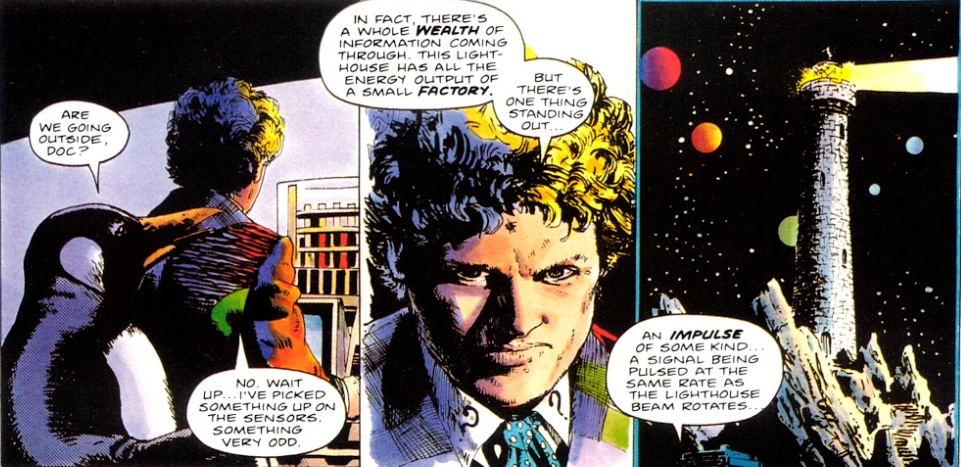
My next mission was to head to the library and try to find some primary sources of graphic novels or comic books. I found a comic book by Herge, it was called ‘The Adventures of Tin Tin: Destination Moon’. The cover instantly caught my eye because the main characters were in a jeep travelling to a rocket. I could assume they’re heading to the moon as the title is a big giveaway and there is a rocket.

Published March 1950
I have found an example on page 3 that portrays the passing of time through the use of frame by frame squares and this is clearly shown through the narrator’s speech “Two hours earlier…”

Another example on page 4 suggests the place is stated when Tin Tin tells the captain that there is a signboard. In the bottom left frame, it clearly shows they are travelling across a mountainous area. It also portrays the passing of time again in the narrators speech.

I found this exercise very difficult and I struggled to understand it. I have done what I can but I believe I could have broaden my research, however, it was just a challenge for me overall.
Part 3:4 – Knitting Patterns
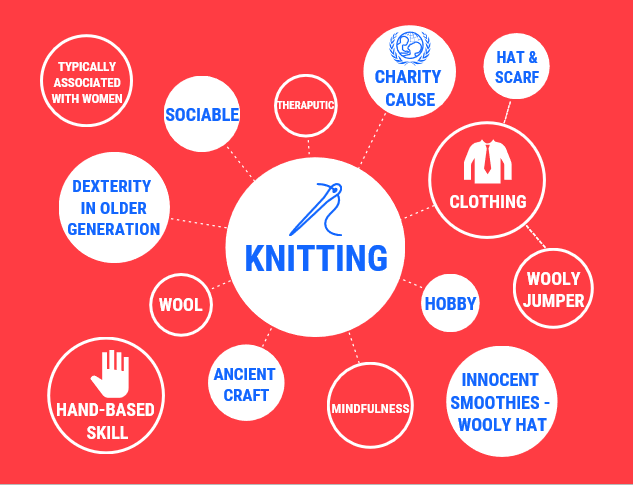
Contemporary Knitting
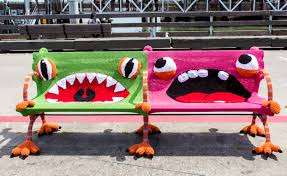
The first thing I research was yarn bombing, even the word sounded cool. Lorna and Jill Watt have yarn-bombed many things in the past but the main one that caught my eye was the Buttmunches. It’s their most recent project that went viral and it is such a creative piece of art.
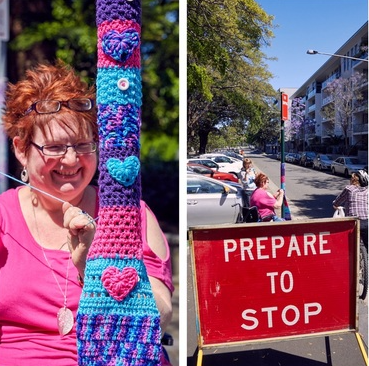
I came across ‘Queen Babs’ also known as Jane, when my mum showed me her artwork on Instagram. She also does yarn bombing, Her work is very colourful street art and she produces this work to “add colour to the city and make people smile”. I believe her work does exactly that. An article on the Daily Telegraph tell us exactly what she does and why. She takes donations from the public which helps fund her wool but she also gives an amount to charity.
Knitted items have become more popular again nowadays such as knitted jumpers. We associate knitted jumpers with winter, mainly known as ‘Jumper Season’.


The last thing I will mention is Sushi Amigurumi. It s a food set by Ami Amour. It really caught my eye as it is unique and different.

Historic Knitting
The next thing I came across was knitted clothing. Clothing was kitted for soldiers in the war to keep them warm. It prevented trench foot which could later lead to death.


I found a piece of artwork by Rowland Wheelwright (1870 – 1955) entitled ‘Irene Knitting In An Easy Chair’. It depicts a lady sitting in a chair knitting in front of an open fire.

http://www.artuk.org/artworks/irene-knitting-in-an-easy-chair-234978
Assignment 3: Reflection
Part 3 was definitely a challenge for me as I struggled to understand the subject. Visual communications aren’t necessarily hard to come to terms with because its literally communicating visually. Its when I start to break down an image and look into the deeper meanings, that’s when I found it difficult. I really enjoyed doing the knitting patterns exercise as my nan loves to knit so I got her involved in it with me. She told me everything she knows because I believe she has done it for many years now.
Semiotics was quite difficult for me at first because I couldn’t understand the sign = signifier + signified. I think that because I struggled with this exercise, it put me behind on the other work. It took me a while to figure out but once I got there, it was alright but I just hope I understood it correctly. I also really enjoyed doing the film posters as I am familiar with analysing the details. For GCSE Media, one of our projects was all about analysing film posters and then designing our own poster. I chose to analyse my favourite film ‘Snatch’ because I’ve seen that film more times than I can remember so it was fun to dig deeper.
When I finally got to the assignment, I knew that I wouldn’t be able to complete it in such short time as I was already behind so I got an extension but I think it actually helped more because I completed it better than the others. That’s my opinion anyway. Again, I struggled at first but I came to terms with it pretty quickly. I chose to focus on the Mona Lisa painting and the re-appropriated version of her in Andy Warhol’s piece ‘Thirty Are Better Than One’. Mona Lisa was another piece of art that was first introduced to me in school in GCSE and A-level Art so it was exciting to discuss it again.
Overall, this Part of my course was challenging but I have definitely learnt from it and I will probably consider it more in the future.
Word Count: 350
Assignment 3: Re-appropriating Images
In this assignment, I was instructed to identify an example of re-appropriation within visual communications. It could be illustrators or designers drawing from wider visual culture or advertisers using ideas from films. I will look at the original image and complete a semiotic analysis with its contents and possible meanings. The two pieces of work that I will be analyzing are the ‘Mona Lisa’ by Leonardo Da Vinci and ‘Thirty Are Better Than One’ by Andy Warhol.
Firstly, I started with researching re-appropriation. I found a definition that suits it perfectly.
Appropriation in art and art history refers to the practice of artists using pre-existing objects or images in their art with little transformation of the original
As explained in the Tate Modern website Art Terms.
There is a fine line between appropriating and copying, if you copy someone’s work you should give credits where and when it is due to respect the artist. Otherwise, it is classed as plagiarism. Further down on the Tate Art Terms, it mentions a few artists such as Marcel Duchamp with his urinal artwork. He re-appropriated Leonardo Da Vinci’s ‘Mona Lisa’ by drawing a moustache and a goatee on a postcard version of the painting. Jasper Johns (born May 15, 1930) is also mentioned, I further researched him and he has re-appropriated ‘Mona Lisa’ as well. However, his piece ‘The Seasons (Summer)’ features ‘Mona Lisa’ in a different way, she is seen slightly towards the back of his piece. These images have inspired me to use ‘Mona Lisa’ because she is very famous and many artists have re-appropriated Da Vinci’s painting. The painting has been mass reproduced on items such as coffee mugs, postcards, t-shirts and so on. Does this then effect the meaning of the painting? I believe it makes mundane due to easy access, it takes the fun out of not knowing.
I will begin with a semiotic analysis for the original painting. For instance, Da Vinci used oil paint on a wood panel, he used a technique called Sfumato a revolutionary new technique of his time which consists of blending of light and shade. It is a portrait painting of Mona Lisa seated in a chair, her body angled slightly to the left but face and chest turned towards the viewer. Her facial expression is a half-hearted smile and her eyes directly gazing at the audience. As an observer, you might first notice that she has no eyebrows, however, I am unaware if that was intentional or just due to the age of the painting. Her left arm is placed resting on the arm of the chair, her right arm is resting on top of her left arm and she is wearing a dark-coloured dress. She is positioned against a scenic background, the bottom half that is in line with her chest and shoulders is very mountainous scenery with a wooden bridge to one side. Further up, in line with her head and eyes is what seems to be a lake with smoky blue colours.
There are a few possible meanings that this painting has. Firstly, her crossed arms could be suggesting the side of her wanting to protect herself. When people sit or stand with their arms folded, it suggests they are protecting themselves or feel insecure. The next important thing to discuss would be her smile. It is a half-smile with the corners of her mouth raised. A smile is a visual representation of happiness so this could imply that she is content with being painted. Her gaze, on the other hand, is quite mysterious and her eyes follow you wherever you walk which suggests she is watching down on her viewer. The Mona Lisa painting was originally commissioned for Francesco del Giocondo, however, the client never received it as Da Vinci kept it for himself. She was painted in Florence, Italy in the 16th century between 1503 and 1506 and considered the greatest treasure of renaissance art by most people.
Mona Lisa is currently permanently located at the Louvre Museum in France. I accessed the image online at mymodernmet.com, this website had an extremely clear photo of the painting and looking closely it is possible to see the age-related cracks in the wood. Having never seen the original in person due to living in the UK and the artwork is in France, I would like to visit her at some point when I travel through France to Spain. “So it’s finally possible to ask yourself critically: is she worth it?” (Johns, J. 2005) Most people believe it’s not worth traveling to see her unless you’re a big Da Vinci fan or happen to be in Paris.
There are a variety of examples of re-appropriation with Mona Lisa such as Marcel Duchamp’s ‘L.H.O.O.Q’ or Jasper Johns’ ‘The Seasons (Summer)’ but I have chosen to focus on Andy Warhol’s ‘Thirty Are Better Than One’. The title itself ridicules a consumer society that loves quantity over quality. In 1963, whilst successfully touring the United States, the Mona Lisa caught Warhol’s eye and that he was inspired as much by the ubiquitous nature of the image as its historical importance. Warhol was obsessed with the celebrity cult so of course, he had to re-appropriate Mona Lisa. “He proposed that fame was a commodity, and that the endless replication of a celebrity’s face made it so.” (Keats, J. 2013). He produced a series of works in various sizes and colours, all relating to the original painting. The final piece was published on the occasion of the 1997 exhibition “Andy Warhol: Thirty Are Better Than One” at the Tony Shafrazi Gallery, NY.

Figure 1. Leonardo da Vinci (c.1503-06) Mona Lisa 
Figure 2. Warhol, A. (1963) Thirty Are Better Than One
I have placed the two next to each other to compare the similarities, differences and discuss how the new references the old. The first comparison to make is obvious, the original has been used but the difference is there is 29 more in Warhol’s version. He referenced the original but just repeated multiple times and made smaller like a grid. Another difference is the colour and medium used; Da Vinci’s is in colour oil paint and Warhol’s is black and white silkscreen. The line, form, and value are all similar as he has taken those elements from the original, however, shape and space have changed because he has repeated the image so shape and space would be larger. The texture of each image is different from one another because of the medium used. All these elements have been used to create meaning, the title is “Thirty Are Better Than One” so that explains the use of repetition.
Andy Warhol embraces mass consumerism and reproduction within his piece, he says ‘More is better’. He challenges the idea of valuing only the original piece. Da Vinci has challenged his viewers with trying to understand the mood behind her smile. Andy Warhol was inspired and followed in Duchamp’s footsteps after he drew the moustache and goatee on Mona.
Word Count: 1118
Bibliography
Tate – Art Term – Appropriation. At: https://www.tate.org.uk/art/art-terms/a/appropriation [accessed 02/12/19]
Jasper Johns – born 1930. At: https://www.tate.org.uk/art/artists/jasper-johns-1365 [accessed 02/12/19]
The History and Legacy of Leonardo da Vinci’s Mysterious ‘Mona Lisa’. By Kelly Richman-Abdou, June 15, 2019. At: https://mymodernmet.com/leonardo-da-vinci-mona-lisa-facts [accessed 03/12/19]
Did You Know – The Mona Lisa. At: https://www.jerrysartarama.com/blog/did-you-know-the-mona-lisa [accessed 03/12/19]
Oi, Lisa, Over Here! By Jonathon Jones, April 11, 2005. At: https://www.theguardian.com/culture/2005/apr/11/1 [accessed 04/12/19]
If Every Artist Were As Good As Andy Warhol Forgery Would be Unnecessary. By Jonathon Keats, January 15, 2013. At: https://www.forbes.com/sites/jonathonkeats/2013/01/17/if-every-artist-were-as-good-as-andy-warhol-forgery-would-be-unnecessary-book-excerpt/#6f4880ff6080 [accessed 04/12/19]
Mona Lisa Takes New York. April 24, 2015. At: https://www.christies.com/features/Andy-Warhols-Colored-Mona-Lisa-5916-3.aspx [accessed 12/01/20]
Room One: Urban
I was asked to examine a location in a movie and how that environment may be perceived differently. On page 34 of Place – Room One: Urban, it talks about how a certain location can be recognised as scenes from a film setting. Everything is perceived differently by different people. It depends on the way your brain works. On page 35, Liam Gillick talks about Stanley Kubrick’s film “A CLOCKWORK ORANGE”. He says “Kubrick was concerned that the vision of Britain portrayed in the film would encourage violence and social unrest.” You could say this about most crime films that are seen on TV or Netflix such as Brotherhood. A better example would be the new film that has recently been released called “Blue Story”. It all about gang war and fighting for postcodes in London. Obviously if you haven’t seen the film then you won’t recognise the area from that. So I do believe that locations can be perceived differently in different context.

This is a scene from the Blue Story film, which was based in Peckham.
 A Journey Through a Creative Arts Degree