Photographs are a significant part of our lives because it shows us the memories of our pasts. When my family talk about our pasts, it’s good to have visuals. I have never met my grandad on my mothers side but she always shows me photos of him so it allowed me to look into her past. Everyone wants to keep those precious memories tight in our possession, photos that people would most likely save from a house fire.
Is flicking through images on someones phone or digital photo frame as potent as looking through an album or sorting through a box of photos? Or is it better?
I believe it doesn’t matter whether you’re looking through a box of photos or through someones phone, it all has the same effect. It brings back feelings of nostalgia. Obviously, its much better to hold a photo in your hand but I believe it doesn’t change the effect. Before the digital revolution came around, you had to get your photographs printed to see them so you wouldn’t know if the image would be blurry or not. I guess thats one disadvantage of digital revolution, photos aren’t as natural anymore because if one is taken but it isn’t right, they delete it and retake.
Does the mechanical nature of photography make it a medium uniquely suited to portraying time and the passage of time?
I would agree with this question because photography does capture time , a certain time/event in life and it can even capture the passage of time. For example, although the time lapse feature on the iPhone is a video, it still captures the passing of time. However, you can get a photo of the passing of time using the shutter speed setting on a camera. The photo below is made using high speed photography. I did have a time lapse video of us travelling through the mountains in Spain but the video wont upload so I got a snapshot of it instead.
Can other creative forms deal with the concept of time to the same extent?
The only thing I can think of to answer this question is a piece of art portraying decay. I remember researching Damien Hurst in school and one of his artworks portrays the passing of time through decay. The Physical Impossible of Death in the Mind of Someone Living. This image shows the shark in the tank, another image shows the shark ageing over time.
Derek Trillo – Passing Place, Manchester, 2006 – this image consists of two people passing each other on a staircase, one is going down and the other is going up. The people are black figures and the silhouette is blurry and we can see their legs moving suggesting they are in motion. The background is very colourful, could possibly be LED screens.
Harold Edgerton – Bullet and Apple, c.1964 – this image consists of an apple resting on top of a bullet shell with another bullet being shot through the middle of it against a blue background. The entry and exit points of the bullet look like mini explosions emphasising the damage done. This image is very fascinating as it had captured it at the correct moment in time the bullet went through the apple. The human eye would not be able see clear because the bullet travels too fast. This links back to my previous exercises.
Harold Edgerton – Multiflash tennis serve, 1949 – this image is a tricky one to describe compared to the first two. The background of the image is black, there is a blurry white figure in the centre that seems to be playing tennis. The action suggests the figure is hitting the tennis ball. It looks like a strobe light could have been used to capture the sport.
Jacques-Henri Lartigue – Cousin Bichonnade in Flight, 1905 – this is a black and white image that consists of a woman wearing a long skirt and black shirt jumping down a stone staircase. She looks as though she is hovering above the staircase. Lartigue was 9 years old when he took this shot, I can imagine how excited he was to see this image develop back then.
These are images that I have taken myself. The first image is my partner and I walking through the shopping centre. You can see we are in motion as the image is blurry and you can see our legs kick out. The second image is a fire we had one night, it shows the red timbers flying away when the wood cracks. The capture has caught them moving so they look like lines. The third image is my friend drawing in the air with a sparkler, this is interesting because the shape is so clear.
After reading Gareth Dent’s article ‘Dealing with the flood’ and it is interesting to see other people interpretations on “the flood”. In basic terms, the ‘flood’ is all the photos added to the internet in 24 hours, which is a lot hence the word flood. I use photographs to show friends and family what I get up to or where I’ve been. Other people use photos to portray the life they wish they have. However, some people use social media to post photos of their hobby, artwork, or business. I would say I contribute to the flood with my own photographs, not everyday but maybe twice a week. I enjoy adding to the global flood to make myself known every now and again. Of course, I wouldn’t just post anything random, most people have a theme going on their feed.
There are a few particular points in Walker’s essay that I’d like to discuss further:
With each shift of location the photograph is recontextualised and as the context changes so does the meaning.
The first point I feel is correct is right at the beginning where he mentions a wedding photograph and the different contexts it can take on in different locations. For example, he says a wedding photo on someones mantlepiece is a memento whereas a wedding photo in a photographers shop shows off the style of work for that photographer.
The frame of the photograph encloses a space, a world, which we can enter (in our imaginations)
I believe this point is correct because a photo captures only what is in its frame, so it encloses that certain space. However, I cant help but think what if the photo was 2 inches wider, would it change the context?
Two people can identify an image completely different to one another, everyone is different and each have all had different experiences in life.
every person’s response to an image is different and exclusive to them
For example, one person could see an image and think nothing of it at all but the next person to see it could have a huge impact on them, for instance it would bring back certain memories for that individual.
I was given the task to flick through a photo album and pick out any photos that are considered “artistic”. It is hard to pick out photos that are considered art because I believe that any photograph can be considered art as no two photos are the same even if the the subject matter is the same. There are a few different photos that I have found that I would consider art in their own ways. See my chosen images below.
The first image is a photograph of my friend and I at our prom night. I believe this photo can be considered art because it has captured a very significant moment that wont happen again. The next two images are photos taken of the sky in different places and different times. This can be seen as art because nature is beautiful and deserves to be captured. The final image is a photo of some street art that I saw in Norwich. This is art because it takes skills to be able to paint like this but also it sends a nice message to its viewers.
The next task was optional but I decided I would give it a go. I was asked to take some shots in my neighbourhood that were purely ‘utilitarian’. I had to find the definition before I went out so I knew what I was looking for. Basically it means something that is designed to be useful rather than attractive. Then try to produce a photo that is more ‘arty’. The first two photos I took mainly showed what my village looked like, for example, the first image is the beginning of Station Road. The second image is a patch of green that is used for kids to play on. The next two photos showed the beautiful buildings that could be considered art and the final image of the sky is taken from my back garden which i have included because it is beautiful.
I am very excited to start this part of the course as Photography is a passion of mine. I currently have a Sony DSLR camera and I really enjoy taking photos of almost anything. Photography has been around since 1826 when the first photograph was taken by Joseph Nicéphore Niépce. Camera Obscura is a model dating back to the 4th century in Greece, a device that projects an inverted image of the view through a hole in the wall.
Renaissance
Caravaggio, born September 1571 in Italy, was one of the first people to use the camera obscura. I found an article discussing whether Caravaggio was the first photographer or not.
The Italian artist has long been suspected of turning his studio into a giant camera obscura, punching a hole in the ceiling to help project images on to his canvas. But new research claims that Caravaggio also used chemicals to turn his canvases into primitive photographic film, “burning” images he then sketched on to for works such as St Matthew and the Angel.
Tom Kington, March 11, 2009.
Contemporary
Abelardo Morell, born 1948, is a modern practitioner who also uses camera obscura. He would cover the windows in house with black plastic then cut a small hole in the middle. This allows the inverted view from outside to be projected on the back wall inside. The image below shows his work. You can see the room is obviously some sort of play room or child’s bedroom considering the toys. The view from that bedroom window is clearly projected onto the opposite wall but upside down, which gives you… camera obscura.
Camera Obscura: View in Brady’s Room, 1991
“…photography freed painting from a lot of tiresome chores, starting with family portraits”
Pierre-Auguste Renoir (Coke, 1964, p.66)
Research
The Pencil of Nature
After reading the introductory sections, I think it’s fair to say photography can be both mechanical and creative. Talbot heavily focused on the scientific research that goes into developing photography, trying to figure out the process. A painting usually requires a skilful artist, whereas a photograph necessarily doesn’t. The process itself involves mechanical devices however it is the creative stimulation that triggers it.
Exercise 1
Photography is unique as an art form because it captures the moment. When a fun day out with the family wants to be remembered in the future, you capture the moment by taking a photo. Looking back on old family photos can bring back feelings of nostalgia.
Often the camera can capture what the human eye cannot see. For example, the human eye is able to observe events at fast paces, however, it can’t freeze time or moments. Whereas a camera can, as shown below.
Google Images
A photograph doesn’t necessarily have to exist in a hard copy. In my opinion, whether a photograph exists in a hard copy or digitally on a phone for example, I believe either can bring you the feelings of nostalgia. However, within art, I think it depends on the context. For a photograph to be considered art, I think the best way to do that would be a hard copy.
“The context in which a photograph is seen… [affects] ..the meanings a viewer draws from it”
The definition of cutting edge means the most advanced developments. For example, for every mainstream Facebook, there are dozens of smaller companies testing out new ways to engage an audience online.
Futurefarmers.com is an interesting page about farmers that have created new technology such as “Wind Theater” (2019) and many other designs “for exchange that catalyse moments of ‘not knowing'”. Communiculture is a website that seems basic with the logo as that main screen, however, I cant seem to get passed the login screen. I also couldn’t access Theyrule.net as it was stuck on the loading screen.
I decided to research sites that interact with the viewer. It’s hard to know what to search when looking for these things. I have come across Ono, it is a zero waste and highly personalized meal delivery service that uses your body statistics to personalise your order. The website uses contrasting earthy tones to separate the visuals from the text. It guides the audience through the process of personal health and dietary options to suggest the best food recommendations.
Another example of interactive design is the Nike By You. I remembered I used to design my own trainers on this website when I was younger. You could personalise the colours you like and what styles.
The examples I have found suggest they are messages to persuade or entertain people to draw in more clients or customers.
For this exercise, I was asked to find examples of different visual conventions used to convey time and/or place. I was given the option to explore the OCA online library and use some of the resources on there. I tried to research graphic novels and comics on there but I struggled to find anything.
I researched graphics novels on the normal browser and I found an article that tells us the best comic book artists. There was a few names mentioned such as Marnie Galloway, Craig Thompson and Fiona Staples and many more. They have all won Eisner awards for their work, for example, Craig Thompson won the 2004 Eisner award for Best Graphic Album.
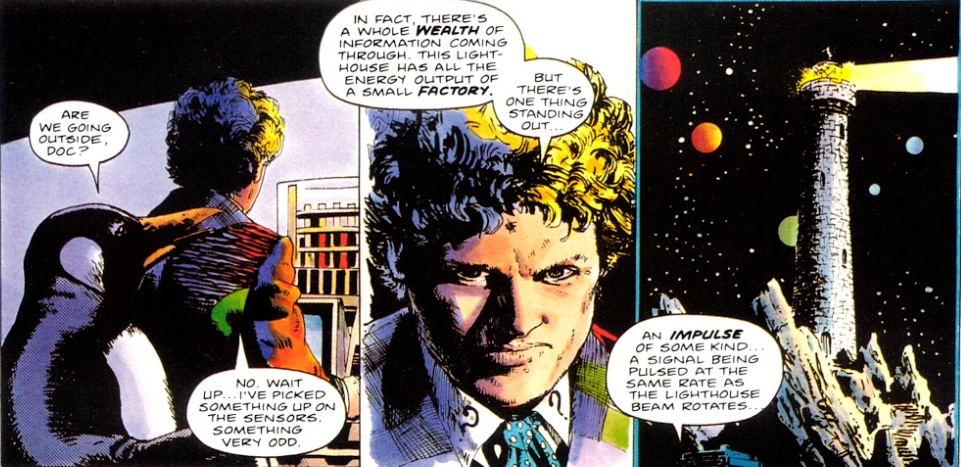
I got thinking and I then researched the Dr Who graphic novels and came across some interesting things. The novel explores the theme of place through multiple frames. We already know that Dr Who teleports to different locations so that challenges the idea of place. We can see here below that he mentions the North Pole. Then below, the doctor gets into the tardis and travels to a new location.
My next mission was to head to the library and try to find some primary sources of graphic novels or comic books. I found a comic book by Herge, it was called ‘The Adventures of Tin Tin: Destination Moon’. The cover instantly caught my eye because the main characters were in a jeep travelling to a rocket. I could assume they’re heading to the moon as the title is a big giveaway and there is a rocket.
The Adventures of Tin Tin: Destination Moon. By Herge. Published March 1950
I have found an example on page 3 that portrays the passing of time through the use of frame by frame squares and this is clearly shown through the narrator’s speech “Two hours earlier…”
p.3 of Destination Moon, By Herge.
Another example on page 4 suggests the place is stated when Tin Tin tells the captain that there is a signboard. In the bottom left frame, it clearly shows they are travelling across a mountainous area. It also portrays the passing of time again in the narrators speech.
p.4 of Destination Moon, by Herge.
I found this exercise very difficult and I struggled to understand it. I have done what I can but I believe I could have broaden my research, however, it was just a challenge for me overall.
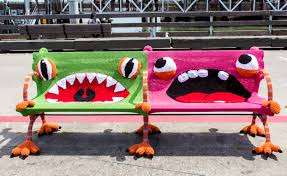
The first thing I research was yarn bombing, even the word sounded cool. Lorna and Jill Watt have yarn-bombed many things in the past but the main one that caught my eye was the Buttmunches. It’s their most recent project that went viral and it is such a creative piece of art.
Knitsforlife.com
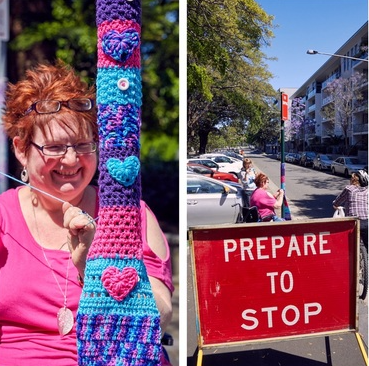
I came across ‘Queen Babs’ also known as Jane, when my mum showed me her artwork on Instagram. She also does yarn bombing, Her work is very colourful street art and she produces this work to “add colour to the city and make people smile”. I believe her work does exactly that. An article on the Daily Telegraph tell us exactly what she does and why. She takes donations from the public which helps fund her wool but she also gives an amount to charity.
Knitted items have become more popular again nowadays such as knitted jumpers. We associate knitted jumpers with winter, mainly known as ‘Jumper Season’.
The last thing I will mention is Sushi Amigurumi. It s a food set by Ami Amour. It really caught my eye as it is unique and different.
Historic Knitting
The next thing I came across was knitted clothing. Clothing was kitted for soldiers in the war to keep them warm. It prevented trench foot which could later lead to death.
I found a piece of artwork by Rowland Wheelwright (1870 – 1955) entitled ‘Irene Knitting In An Easy Chair’. It depicts a lady sitting in a chair knitting in front of an open fire.









 A Journey Through a Creative Arts Degree